The first time I went to see pandas in Chengdu, I completely messed it up.
I stayed out too late the night before eating hotpot near Yulin Road, went way too heavy on the spicy broth, and woke up late feeling half alive. By the time I entered Chengdu Panda Base, it was already after 10 in the morning.
And honestly?
Almost every panda I saw looked like a giant black-and-white laundry bag thrown onto a tree branch.
One was sleeping face-down on a wooden platform.
Another had its back turned to the crowd.
A third one was stretched out so perfectly still that a tourist next to me whispered:
“Wait… is that one real?”
That was the moment I realized something nobody had explained clearly enough online:
Seeing pandas is all about timing.
The second time I went, I arrived before 7am.
Completely different experience.
The pandas were climbing trees, stealing bamboo from each other, rolling around, making weird squeaky sounds, and chewing bamboo loudly enough that you could actually hear it from the crowd.
That version of Chengdu Panda Base feels magical.
The sleepy version most people see after lunch?
Not so much.
Yes.
But only if you understand what kind of place it is.
A lot of first-time visitors imagine something like a traditional zoo.
It doesn’t really feel like that.
The giant panda area is huge, green, surprisingly peaceful in some corners, and honestly much more emotional than I expected the first time.
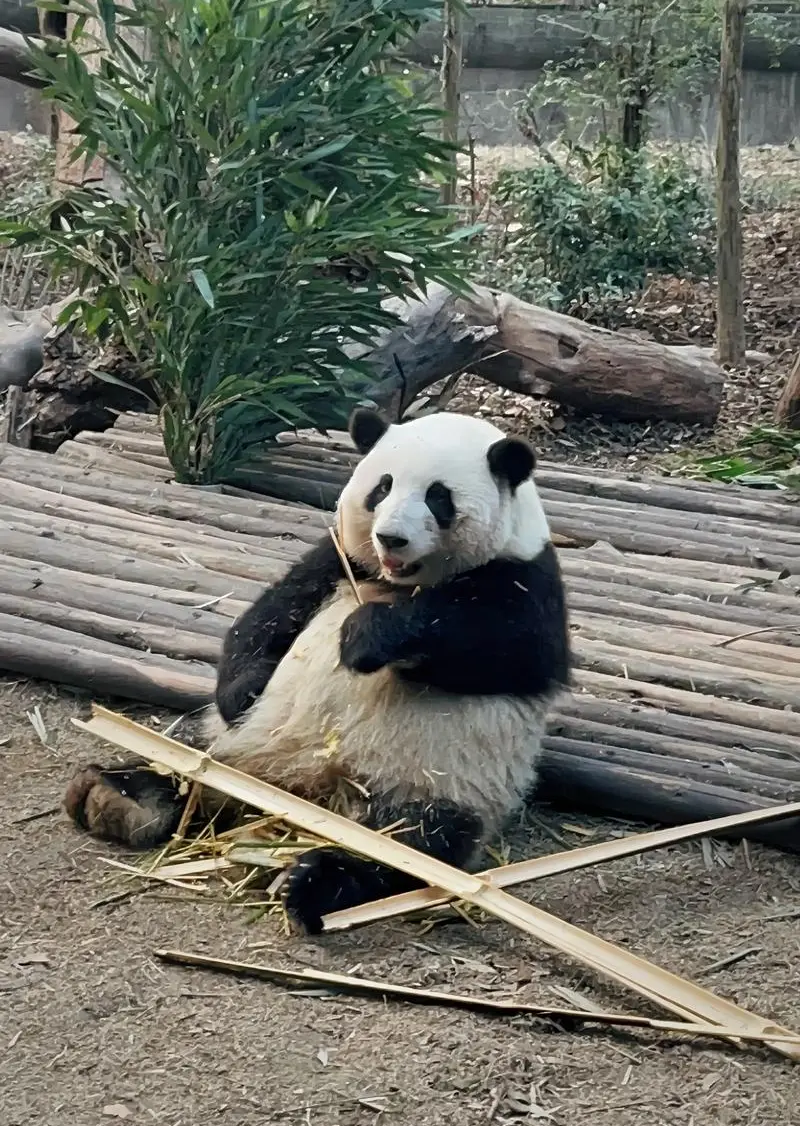
There’s something weirdly calming about watching a panda sit alone eating bamboo in total silence while hundreds of people around it suddenly stop talking for a moment.
And unlike many animal attractions in Asia, Chengdu Panda Base is actually well maintained.
That said…
It can also become extremely crowded.
Especially if you’re trying to see the celebrity panda:
Huahua.
Before coming to Chengdu, I genuinely didn’t understand panda fandom.
Then I saw the crowd around Huahua’s enclosure.
Now I understand.
Huahua became massively popular online because she looks unusually round, slow, and permanently confused.
In person, she somehow looks even rounder.
People lose their minds when she waddles a few steps.
The first time I finally saw her, I probably had about twelve seconds before staff started moving people along.
And honestly?
Worth it.
But here’s the problem:
Everyone else also thinks it’s worth it.
During holidays and weekends, the Huahua area can become absolutely packed.
Sometimes you’re not even looking at the panda — you’re looking at hundreds of phones trying to film the panda.
One woman near me literally brought binoculars.
I respected the commitment.
Earlier than you want to.
Seriously.
This is probably the single most important thing in the entire guide.
There’s a very high chance most pandas will already be asleep.
Especially in warmer months.
Pandas hate heat.
Once the temperature rises, many of them disappear indoors or flatten themselves into giant furry cushions under the shade.
This is why some tourists leave disappointed.
Not because the pandas aren’t there.
Because they came too late.
Roughly:
That’s when they:
Early morning pandas feel alive.
Afternoon pandas feel like abandoned bean bags.
Depends on the season.
Aim painfully early.
I arrived around 6:50am during a holiday once, and there was already a line outside the South Gate.
People were carrying coffee, soy milk, breakfast buns, camera gear…
half awake but fully committed.
And when the gates opened?
People started speed-walking like it was the beginning of a marathon.
One local guy next to me said:
“Everybody’s running to Huahua first.”
He wasn’t joking.
Honestly, arriving around 8am to 8:30am is usually fine.
The first giant rush settles down a little by then.
That’s probably the sweet spot if you want a less stressful experience.
Usually yes.
But this is one area where China can still feel a little confusing for first-time travelers.
The biggest issue is not the ticket itself.
It’s the ecosystem around it:
I’ve seen foreign tourists standing outside the entrance trying to figure out payment apps while the morning panda hours slowly disappeared.
Do yourself a favor:
Book ahead.
Don’t “figure it out later.”
Especially during Chinese public holidays.
For first-time visitors?
I’d still say South Gate.
Mainly because:
But South Gate is also where the chaos happens.
If you hate crowds, the West Gate experience feels noticeably calmer.
I once entered through the West Gate on a cloudy morning after light rain.
The bamboo smelled damp, birds were loud in the trees, and for a few minutes it honestly felt more like a forest park than one of China’s busiest tourist attractions.
That side of the panda base surprised me.
Bigger than most people expect.
And much hillier.
This is not a “quick one-hour stop.”
If you properly explore the place, you’ll probably walk:
Especially if you bounce between the older panda villas and the newer areas.
And Chengdu humidity makes the walking feel harder than it sounds.
In summer, by 9:30am my T-shirt was already sticking to my back.
That sticky Sichuan humidity hits differently.
In summer?
Absolutely.
Especially if:
The distances inside the park look short on maps.
They don’t feel short once the heat kicks in.
In cooler months though, walking is actually pretty pleasant.
One of my favorite visits happened in December.
Cold grey sky.
Barely any tour groups.
Steam rising from coffee cups.
Bamboo leaves rustling in the wind.
Totally different atmosphere from summer chaos.
Because red pandas actually move.
That’s the honest answer.
The giant pandas are adorable, but they spend an impressive amount of time doing absolutely nothing.
Meanwhile, the red pandas:
At one point, a red panda sprinted across a tree branch directly above me and scared me so badly I almost dropped my camera.
A local grandfather nearby just laughed and said:
“They’re way more energetic than the big ones.”
He was right.
This is the classic mistake.
People sleep in because they’re on vacation.
Then they show up at noon wondering why every panda is unconscious.
I’ve seen people attempt:
Possible?
Technically yes.
Enjoyable?
Not really.
Chengdu traffic can be brutal.
And the Panda Base itself is more physically tiring than people expect.
Honestly, some of my favorite panda moments happened far away from the celebrity crowds.
A sleepy panda scratching its stomach.
A baby panda falling off a platform.
Two pandas stealing bamboo from each other.
Those random moments usually become the memories you keep.
The food is fine.
Not terrible.
Not memorable either.
I once paid way too much for a bowl of noodles inside and immediately regretted not waiting until I got back into the city.
Chengdu food deserves better than rushed tourist meals.
Personally, I wouldn’t.
For most travelers, staying in central Chengdu makes much more sense.
Especially around:
That’s where Chengdu actually feels alive at night.
Street food.
Mahjong sounds.
Late-night barbecue smoke.
Tiny tea shops.
Scooters everywhere.
One night after eating barbecue near Jianshe Road, I walked back through humid midnight streets filled with chili oil smells and people still eating skewers at outdoor tables.
That feeling stayed with me longer than some tourist attractions did.
That’s Chengdu too.
I think so.
Because it’s not only about pandas.
It’s one of those places where you slowly realize:
people become strangely soft around animals.
You’ll see exhausted travelers suddenly smiling.
Crowds going quiet together.
Adults reacting like children because a panda rolled over dramatically.
There’s something oddly wholesome about the whole experience.
Even with the crowds.
Even with the chaos.
Don’t treat it like a checklist attraction.
A lot of modern travel becomes:
But the best moments at Chengdu Panda Base usually happen when you slow down.
A panda chewing bamboo in complete silence.
Rain starting suddenly over the bamboo forest.
A sleepy crowd collectively laughing because one panda rolled off a platform.
Those tiny moments are the ones that stay with you.
I’ve traveled across Tibet, western Sichuan, Xinjiang, and plenty of remote places afterward.
But every time I return to Chengdu, I still end up wanting to see the pandas again.
Even if they’re asleep.
 Sichuan Baijiu: Yibin and the Liquor Towns
 lao huang386Sichuan Hotpot Beyond Chengdu: Regional Differenceslao huang386Sichuan Street Food Guide: Snacks Across the Provincelao huang386
 Chengdu Street Food Safety: Eating Well Without Getting Sicklao huang386Chengdu Spice Tolerance: Eating Sichuan Food Without Sufferinglao huang386Chengdu Food Tours: Are They Worth Itlao huang386Chengdu Cooking Class: Learning to Cook Sichuan Foodlao huang386Chengdu Noodle Guide: The Bowls Worth Findinglao huang386Chengdu Breakfast Guide: How the City Starts the Daylao huang386Chengdu Vegetarian and Vegan Guide: What to Orderlao huang386
